
Rotational molding is a unique and efficient plastic processing technique widely used to manufacture large hollow plastic products.
The process involves placing powdered plastic resin into a mold, which is slowly rotated and heated along two perpendicular axes, causing the plastic to melt evenly and coat the inner surface of the mold, and finally cooling to form the product.
Rotational molding technology is favored for its low tooling costs, uniform wall thickness distribution, and ability to produce complex-shaped, seamless products, making it an indispensable manufacturing technology across various industries.
This article will systematically introduce the rotational molding process, types of equipment, material selection, and its applications in different fields, helping readers gain an in-depth understanding of the unique value and development prospects of this plastic molding process.
What Is Rotational Molding?
Rotational Molding (commonly known as rotomolding) is a manufacturing process used to produce hollow plastic products, capable of creating parts with wall thicknesses up to 10 mm.
The manufacturing process involves placing plastic powder (or liquid plastic) into a mold, then using heating and biaxial rotation to uniformly melt the plastic and adhere it to the inner wall of the mold, which then cools to form a seamless hollow product.
The heat transfer and mechanical movements during the rotational molding process ensure uniform distribution of the plastic material within the mold cavity, achieving consistent wall thickness and excellent mechanical properties.
Compared to other molding techniques such as injection molding and blow molding, rotational molding requires lower investment in equipment and is suitable for small to medium production volumes.
Rotational molding process is applicable to various polymer powders, especially polyethylene materials, and is widely used in water tanks, medical housings, playground equipment, and other fields.
Rotational molding machines utilize precise process control and heating-cooling cycles to ensure the physical properties and surface quality of the products, making them highly effective in fields such as water tanks, medical housings, and playground equipment.
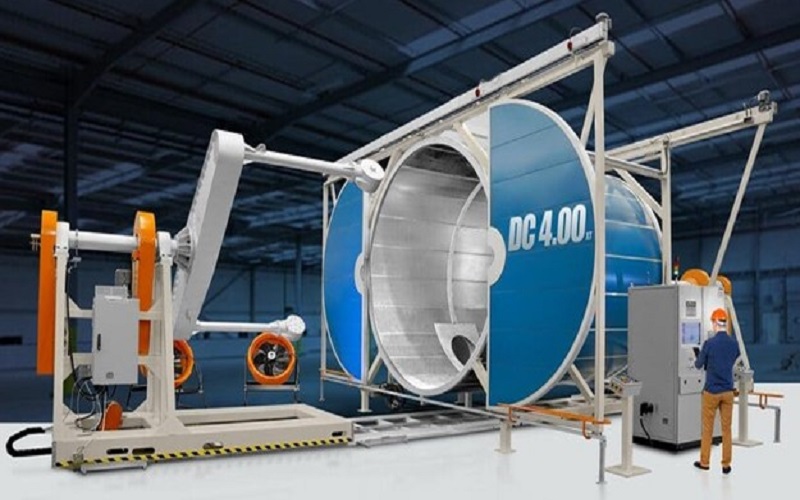
How The Rotational Molding Process Works?
The core process of rotational molding typically consists of four standard steps. The entire process is carried out under relatively low pressure, relying on biaxial rotation of the mold and heating-cooling cycles to uniformly adhere the plastic to the inner wall of the mold, ultimately forming a seamless hollow product.
Loading
Rotational molding begins with loading a precise amount of polymer powder or liquid raw material into a hollow mold.
The mold is securely closed and mounted onto a machine arm that rotates biaxially, meaning it spins around two perpendicular axes. This dual rotation ensures the polymer material spreads evenly over the entire inner surface of the mold.
Heating and Rotation
The heated mold in an oven with forced hot air or infrared while rotating slowly in two directions. Next, the mold enters a heating oven where it is gradually heated to a temperature above the polymer’s melting point.
As the mold rotates within the oven, the polymer resin melts and fuses to form a uniform coating on the mold wall. The heating cycle is carefully controlled to prevent overheating, which could degrade the polymer, and to ensure complete melting and sintering of the material.
Cooling and Setting
Once the polymer has fully melted and adhered to the mold surface, the mold is transferred to a cooling station. Cooling is typically achieved using ambient or forced air, sometimes supplemented with water mist or spray.
The mold continues to rotate during cooling to maintain uniform wall thickness and prevent sagging or warping of the part.
Demolding
After the part has sufficiently cooled and solidified, the mold is opened, and use a mold release agent to easily remove the finished product.The mold is then cleaned and prepared for the next cycle.
Cycle times for rotational molding typically exceed 30 minutes , the mold continuously rotates to promote uniform distribution of the polymer melt, preventing material accumulation or voids, significantly enhancing product quality and consistency.
Throughout the process, precise control of parameters such as mold temperature, air temperature inside the mold, rotation speed, and cycle time is essential to producing high-quality parts with consistent wall thickness, minimal defects, and desired mechanical properties.
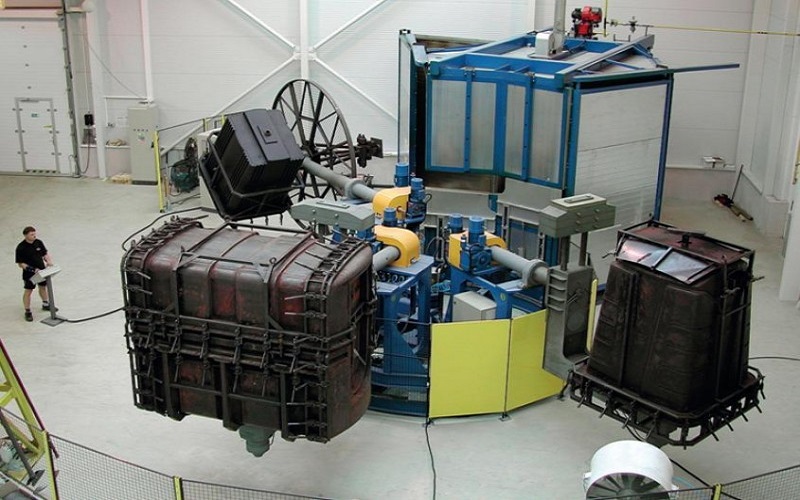
Materials Used In Rotational Molding
Rotational molding has different material requirements compared to processes like injection molding and blow molding.
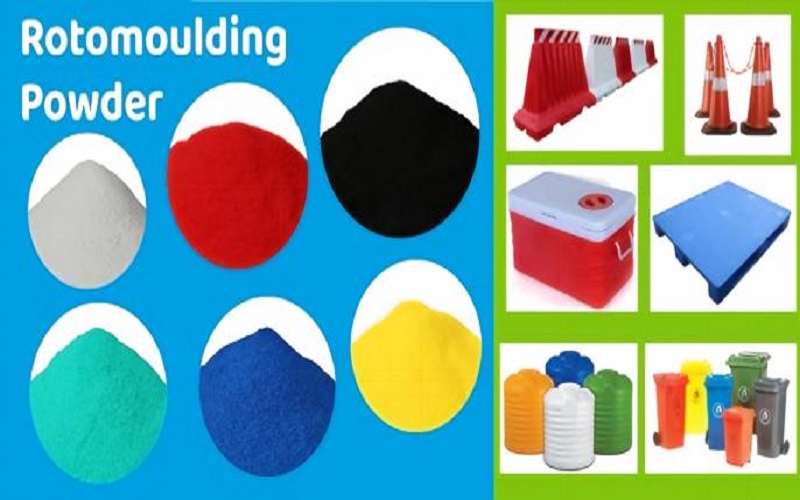
Since the material melts and adheres to the inner wall of the mold under almost no pressure, thermoplastic plastics with good flow properties and high thermal stability, mainly in powder form, are most suitable.
Rotational molding supports various thermoplastic resins,over 80% of the materials used in this process are polyethylene types, including high-density polyethylene (HDPE), low-density polyethylene (LDPE), and linear low-density polyethylene (LLDPE). These materials are favored for their excellent chemical resistance, impact performance, and ease of processing.
Other polymeric materials include polyvinyl chloride (PVC), nylon, polypropylene, and specialty compounds with specific properties such as enhanced thermal stability or mechanical strength, which are also commonly used in the rotational molding industry.
Advancements in material science continue to broaden the range of polymers and composites that can be processed by rotational molding, enabling manufacturers to produce parts with superior performance to meet the stringent demands of industries like automotive, medical, and consumer goods.
Rotational Molding Equipment And Tooling
Rotational molding equipment is a critical component in the manufacturing process, directly affecting product quality, production efficiency, and operational costs.
The equipment primarily consists of molds, heating ovens, cooling chambers, and the mechanical systems that rotate the molds biaxially.
Design Requirements Of Rotational Molding Molds
Molds used in rotational molding are typically hollow, shell-like structures designed to withstand repeated heating and cooling cycles.
Mold Materials
They are usually fabricated from metals with good thermal conductivity and durability, such as cast aluminum, stainless steel, or mild steel.
Cast aluminum molds are popular due to their excellent heat transfer properties and relatively low cost, although they tend to be thicker than steel molds because aluminum is a softer metal.
Mold Thickness
The mold thickness is carefully balanced to optimize heating and cooling times while maintaining structural integrity.
Mold Surface Treatment
Mold surfaces play a vital role in the final product’s appearance and quality. The interior surfaces must be smooth and properly prepared, often treated with mold release agents to facilitate easy demolding and reduce defects.
Venting Systems
Additionally, molds are equipped with venting systems to balance internal and external pressures during heating and cooling, preventing defects such as bubbles or warping.
Complex parts may require multi-piece molds with precise parting lines, clamps, or hinges to allow for easy opening and closing. Some molds incorporate features like internal ribs or inserts to enhance part strength or functionality.
Composition Of Rotational Molding Equipment
A complete set of rotational molding equipment typically includes the following core components:
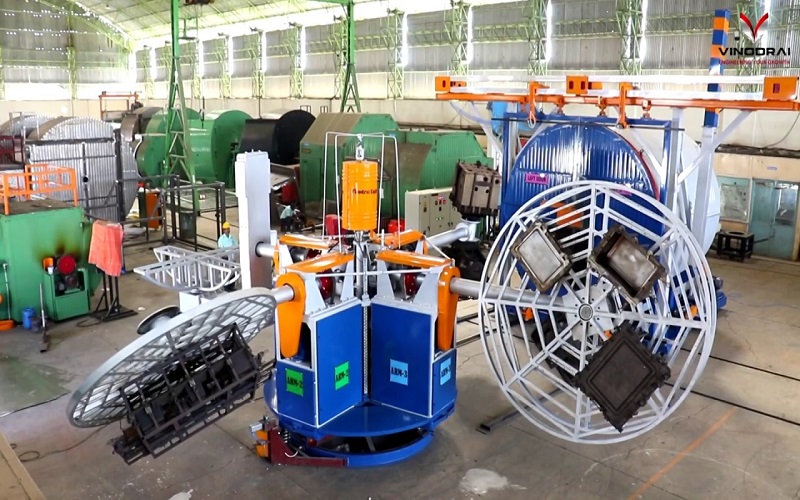
Rotating Arm / Spider: Used to hold the mold and achieve biaxial rotation. Common forms include straight arms, crank arms, and independently driven arms. Modern equipment often employs independent servo drives to precisely control the speed ratio of the two axes.
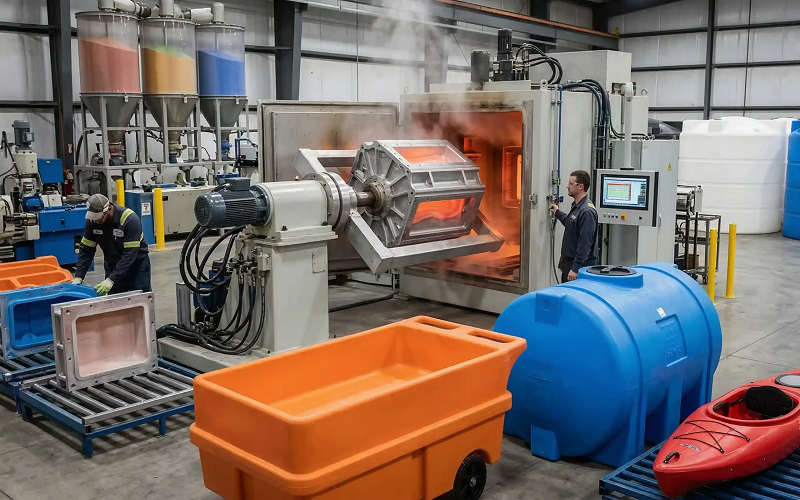
Heating Oven: Provides a uniform heating environment, with temperatures generally controllable between 200–400°C. Common types include gas-fired, electric-heated, or hot oil circulation ovens. Advanced equipment features multi-zone temperature control and hot air circulation systems to improve heating uniformity.
Cooling Station: After the mold exits the oven, it enters the cooling area. Cooling methods include forced air cooling, water mist cooling, or water cooling. Some equipment supports programmed control of cooling speed.
Control System: Modern rotational molding machines generally use PLC or industrial computer control, allowing setting and monitoring of heating time, temperature profiles, rotation speeds, cooling times, and other parameters, enabling process recipe management and data recording.
Rotational molding molds have relatively simple structures and low costs. The equipment centers around “oven + biaxial rotation + cooling.” Although overall automation is not as advanced as injection molding, process stability and production efficiency continue to improve with advances in control technology.
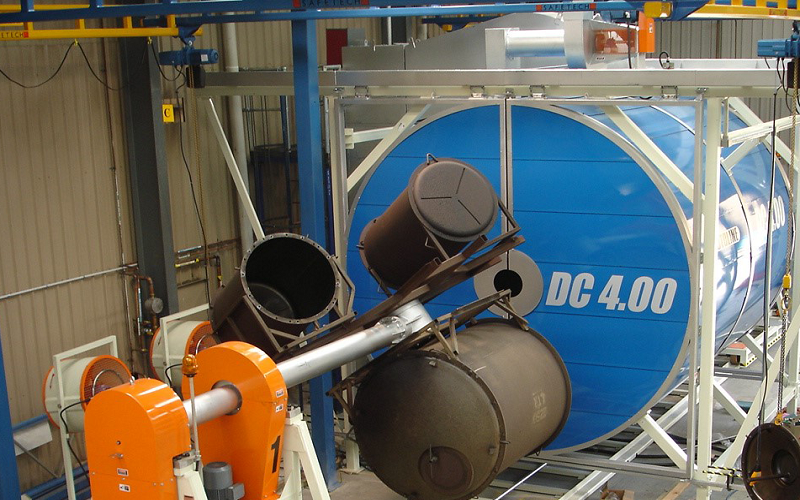
Types Of Rotational Molding Machines
Rotational molding machines come in various configurations, each suited to different production volumes, part sizes, and shapes. The main types include:
Carousel Machines
These machines have multiple arms (usually three to six) mounted on a central turret. Each arm holds a mold and moves it sequentially through loading, heating, cooling, and unloading stations. Carousel machines are highly efficient for medium to high-volume production and allow simultaneous processing of multiple molds.
Shuttle Machines
Shuttle machines operate with one or two arms that move molds linearly between heating and cooling stations. This design allows overlapping of heating and cooling cycles, increasing throughput and making shuttle machines suitable for larger parts or lower production volumes.
Clamshell Machines
Featuring a single arm and a combined heating and cooling chamber, clamshell machines are compact and cost-effective, ideal for small-scale production or prototyping. The mold is opened like a clamshell for part removal, simplifying the process.
Swing Arm Machines
These machines have arms that pivot molds between heating and cooling areas. They are beneficial for parts requiring longer cooling times or for operations where flexible scheduling is necessary.
Rock and Roll Machines
Specifically designed for long, narrow parts such as kayaks or pipes, rock and roll machines rotate molds around one axis while simultaneously rocking them around another. This motion ensures even coating of molten plastic on the mold surface.
Vertical Wheel Machines
Operating similarly to a Ferris wheel, vertical wheel machines cycle molds vertically through heating, cooling, and loading stations. They are commonly used for small to medium-sized parts requiring consistent quality.
Advantage Of Rotational Molding
Rotational molding excels in producing hollow, seamless parts with uniform wall thickness, which is a significant advantage over other molding processes. This manufacturing technique offers several benefits that make it attractive for a wide range of applications:
Low Tooling Costs
Unlike injection molding or blow molding, rotational molding requires relatively simple and inexpensive molds since it operates under low pressure. For products with an annual output of less than 3,000 units, rotational molding is a highly cost-effective manufacturing solution.
Uniform Wall Thickness
The biaxial rotation ensures that molten polymer spreads evenly across the entire mold surface, resulting in consistent wall thickness and minimizing weak spots or thin areas in the finished part.
Low Residual Stress
The low-pressure process and gradual heating and cooling cycles produce parts with minimal internal stresses, leading to improved dimensional stability and durability.
Capability to Produce Large Parts
Rotational molding can manufacture very large hollow parts that would be difficult or uneconomical to produce with other methods, such as water tanks, playground equipment, and kayaks.
Together, these advantages make rotational molding a cost-effective and versatile production process, particularly suited for manufacturing durable, high-quality hollow plastic products with complex geometries and consistent performance.
Limitations & Challenges Of Rotational Molding
Rotational molding offers several advantages, but it also has inherent limitations and challenges that manufacturers must consider:
Long Cycle Times: The heating and cooling stages of rotational molding can take over 30 minutes per molding cycle, which limits production speed compared to faster processes such as injection molding. This extended cycle time can increase labor and energy costs.
Material Restrictions: The most appropriate form of plastic for rotational molding is powder or liquid form. Compared to other plastic processing techniques, the limited availability of suitable powdered materials remains a notable limitation for rotational molding.Additionally, some polymers require special processing conditions due to higher melting points or sensitivity to excessive heat.
Complexity in Achieving Tight Tolerances: Due to the nature of the process, parts may experience shrinkage and slight warping during cooling, making it challenging to achieve precise dimensional tolerances. Designers must account for these factors during mold and part design.
Geometric Adaptability And Material Coverage Issues: Although rotational molding performs well in producing certain shapes such as cylinders and spheres, large flat surfaces are the most difficult to mold rotationally. Additionally, sharp internal corners and deep recesses may hinder the molten material from fully covering the surface, affecting the structural integrity and aesthetic quality of the product.
Despite these challenges, ongoing technological improvements—such as mold pressurization, internal heating and cooling, and advanced process controls—are helping to mitigate many limitations, enhancing the efficiency and quality of rotational molding operations.
Applications Of Rotational Molding
Rotational molding is widely used across various industries due to its ability to produce large, hollow, and durable plastic parts with uniform wall thickness and complex geometries.
This process is especially valued for creating seamless, stress-free components that offer excellent impact resistance and weatherability.
Its cost-effectiveness for low-to-medium production volumes and flexibility in material selection make it a preferred choice in sectors like agriculture, automotive, healthcare, and consumer goods.
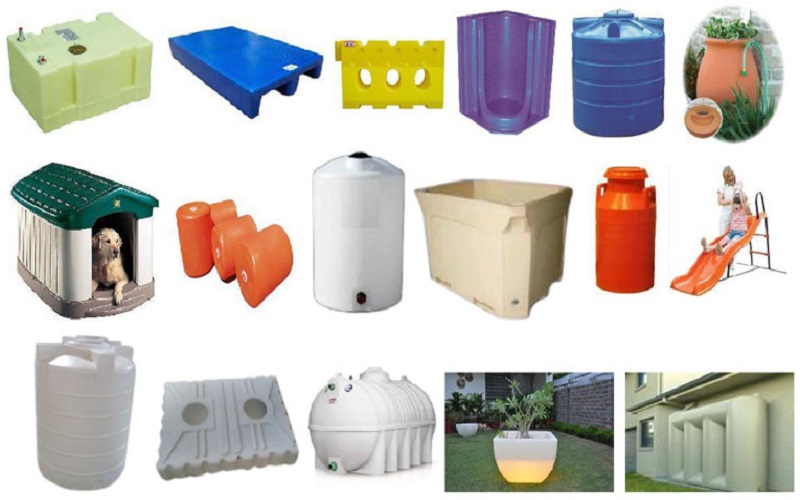
Common products include kayaks, playground equipment, traffic barriers, water storage tanks, chemical containers, and medical housings.
Additionally, rotational molding allows for the integration of molded-in features such as ribs, inserts, and threads, enhancing the functionality of the final product.
What Are the Main Differences Between Rotational Molding And Other Plastics Molding Techniques?
Rotational molding, injection molding, and blow molding are the three most commonly compared plastic processing methods for hollow or plastic product molding. They differ significantly in principles, applicable products, costs, and production efficiency.
Rotational Molding
Rotational molding is a low-pressure, low-shear plastic forming process suitable for producing large hollow products with uniform wall thickness and no seams, such as water tanks, playground equipment, and medical housings.
The process involves slowly rotating the mold along two perpendicular axes, causing powdered or liquid polymer to melt evenly and coat the inner mold surface, ultimately forming the desired shape.
Injection Molding
In contrast, injection molding process is a high-pressure, high-speed forming method ideal for producing complex and detailed plastic parts, especially for large volumes of small-sized products.
Injection molding works by injecting molten resin into a closed mold, which cools rapidly to form the part. It offers high production efficiency but involves higher mold costs.
Blow Molding
Blow molding is primarily used to manufacture hollow containers such as bottles and cans, by blowing molten plastic against the mold walls to form the desired shape. Blow molding is suitable for medium-volume production, with mold costs and production cycles falling between rotational and injection molding.
Overall, rotational molding is favored for its low mold costs and design flexibility, making it suitable for small batches and large, complex hollow products. Injection molding excels in high-precision, high-volume part manufacturing, while blow molding focuses on efficient production of hollow containers.
Comparison Aspect | Rotational Molding | Injection Molding | Blow Molding |
|---|---|---|---|
Process Principle | Mold is heated and biaxially rotated; plastic powder melts and evenly coats the inner surface | Molten plastic is injected under high pressure into a closed mold | A parison (tube-like preform) is inflated to conform to the mold |
Molding Pressure | Almost no pressure | High pressure | Low to medium pressure |
Suitable Products | Large, hollow, complex shapes, thick-walled parts | Precision, small to medium-sized, solid or thin-walled parts | Mainly hollow containers (bottles, drums, cans) |
Part Characteristics | Seamless, very low internal stress, relatively uniform wall thickness | High precision, rich details, complex structures possible | Has parting lines or seams, average wall thickness control |
Tooling Cost | Relatively low | Relatively high (especially for precision molds) | Medium |
Cycle Time | Longer (15–60 minutes per cycle) | Very short (a few seconds to tens of seconds) | Relatively short |
Wall Thickness Control | Relatively uniform, but precise control is difficult | Precisely controllable | Average, prone to uneven thickness |
Material Selection | Mainly PE powder, relatively limited options | Almost all thermoplastics | Mainly PE, PP, PET, etc. |
Batch Suitability | Better for medium-small batches and large parts | Strong advantage in high-volume production | Medium to high volume for container products |
Conclusion
In summary, rotational molding is a specialized process for manufacturing hollow plastic products. Through heating and biaxial rotation, plastic powder melts evenly and coats the inner surface of the mold, resulting in seamless parts with low internal stress.
This process is particularly well-suited for large, complex hollow products that are sensitive to tooling costs, and it offers clear advantages in applications such as storage tanks, water tanks, playground equipment, and marine components.
Compared with injection molding and blow molding, rotational molding has limitations in production efficiency and fine detail precision. However, it excels in part integrity, low residual stress, and the ability to form large structures.
For plastic products that need to be large, hollow, strong, and durable, while produced in moderate volumes, rotational molding remains a cost-effective and reliable choice.