
Delrin injection molding is a widely used manufacturing process that produces precise, durable plastic parts known for their excellent mechanical properties and dimensional stability.
This technique leverages the unique qualities of delrin, an acetal homopolymer, to create components that perform well in demanding applications across various industries.
In this article, we will explore the key advantages, material characteristics, and practical uses of delrin injection molding to help you understand why it is a preferred choice for high-performance plastic parts.
What Is Delrin ?
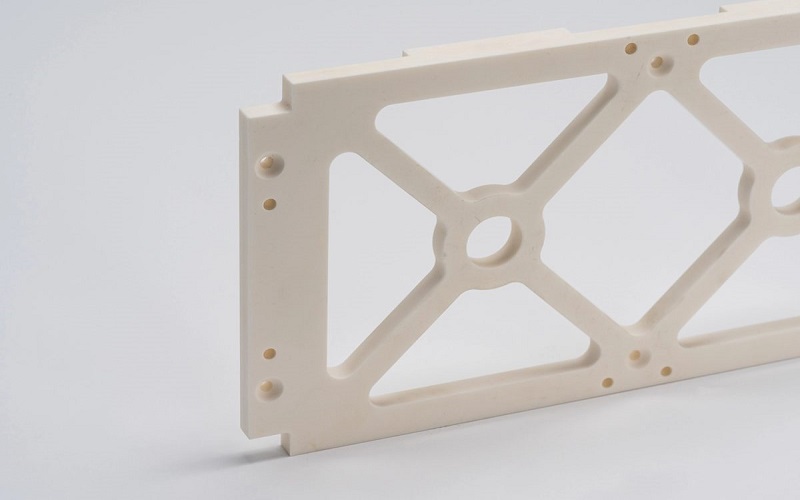
Delrin, also known as polyoxymethylene (POM), is a high-performance engineering thermoplastic developed by DuPont. It is renowned for its excellent dimensional stability, high strength, and low friction, making it especially suitable for manufacturing precision components.
Acetal plastics primarily come in two general types, each with distinct characteristics: copolymer acetal (POM-C) and homopolymer acetal (POM-H). As a homopolymer acetal within this family, Delrin stands out for its exceptional mechanical properties, superior machinability, and versatile design capabilities.
Delrin is available in many grades (such as Delrin AF, which features enhanced wear resistance and self-lubrication), allowing parts to be customized according to specific application needs.
Its excellent toughness and resistance to UV exposure further enhance its durability, especially for outdoor or high-stress applications.
It is well suited for modern manufacturing processes such as injection molding and CNC machining, enabling the production of high-precision parts with complex shapes and thin-wall structures.
Material Properties Of Delrin
Delrin is renowned for its outstanding material properties, making it a preferred material in engineering applications.
It exhibits very high tensile strength and flexural strength, capable of withstanding heavy loads and mechanical stresses without deformation.
Compared to many other acetal copolymer, this homopolymer acetal material offers excellent properties, making it highly suitable for harsh working environments.
Mechanical Properties
The mechanical properties of Delrin include an ultimate tensile strength ranging from 60 to 89.6 MPa and a yield strength between 48.6 and 72.4 MPa.
Wear Resistance
One of Delrin’s key advantages is its extremely low coefficient of friction and excellent lubricity, which grant it high wear resistance.
Delrin is widely used as a lightweight, durable replacement for metal due to its exceptional tensile strength, rigidity, low friction, and high wear resistance.
Chemical Resistance
In addition, Delrin possesses excellent chemical resistance, maintaining structural integrity even when exposed to various solvents, fuels, and strong acids.
This chemical resistance combined with corrosion resistance makes it an ideal choice for applications in wet environments or those requiring contact with highly corrosive chemicals.
Thermal Stability
The material performs well across a wide operating temperature range, typically between -40°C and 120°C, with a melting point around 175°C to 177°C.
This means Delrin parts can maintain their mechanical properties under both low and elevated temperatures, making them suitable for high temperature applications.
Moisture Absorption
Delrin’s very low moisture absorption ensures excellent dimensional stability in humid environments, effectively preventing warping or swelling of parts.
Delrin has a 24-hour water absorption rate of roughly 0.2%, allowing components to maintain structural integrity in humid environments.
However, it is important to note that Delrin has a characteristic known as low density center line porosity, meaning there may be tiny voids inside the material; this must be carefully considered when designing parts that require absolute airtightness or liquid tightness.
|
Property |
Value Range |
|---|---|
|
Material Type |
Homopolymer Acetal (POM-H) |
|
Ultimate Tensile Strength |
60 – 89.6 MPa |
|
Yield Strength |
48.6 – 72.4 MPa |
|
Young’s Modulus |
2.5 – 4 GPa |
|
Elongation at Break |
15 – 75% |
|
Hardness |
14.6 – 24.8 HV |
|
Melting Point |
175 – 177 °C |
|
Operating Temperature |
-40 °C to 120 °C |
|
Water Absorption (24h) |
~0.2% |
In summary, Delrin combines excellent mechanical properties, chemical resistance, and thermal stability, making it a versatile and reliable material widely used in the manufacturing of precision molded parts across various industries.
Challenges and Considerations Of Delrin Injection Molding
When working with Delrin injection molding, several important factors should be considered to ensure optimal part quality and performance.
1. Shrinkage
One key challenge is Delrin’s relatively high shrinkage rate during the cooling phase of injection molding, which can lead to dimensional inaccuracies if not properly managed.
Mold design and process parameters must be carefully controlled to compensate for this shrinkage and maintain tight tolerances.
Attention to wall thickness and uniform cooling is essential to minimize warping and ensure dimensional stability.
2. Temperature Sensitivity
Delrin is also sensitive to temperature during processing. Excessive heat can cause degradation of the polymer, resulting in compromised mechanical properties and surface defects.
Therefore, precise temperature control throughout the injection molding cycle is critical to avoid overheating and ensure consistent part quality.
Maintaining mold temperatures within the recommended range helps preserve Delrin’s better mechanical properties and high resistance to thermal stress.
3. Difficult to Bond
Another consideration is Delrin’s difficulty in bonding with adhesives. Many common adhesives do not effectively dissolve or wet the Delrin surface, which can complicate assembly processes that rely on adhesive bonding.
Alternative joining methods such as mechanical fastening, ultrasonic welding, or using specialized primers are often preferred for Delrin components to ensure reliable assembly and maintain safety restraints.
4. Processing Challenges
Due to Delrin’s high lubricity and stiffness, it requires careful control of injection speed and pressure during molding to avoid defects such as sink marks or voids.
Its slightly harder nature compared to other POM plastics demands optimized mold design to accommodate its flow characteristics, especially for parts with complex geometries or thin walls.
5. Design Restrictions
Designers should consider Delrin’s properties when specifying part features. In design guidelines , the thin walls should meet minimum wall thickness guidelines to prevent deformation, and appropriate radii should be used at corners to reduce stress concentrations.
Understanding Delrin’s high lubricity and increased strength allows for the design of durable, lightweight parts such as conveyor belts and components exposed to low temperatures or hot water.
By addressing these challenges and considerations, manufacturers can fully leverage Delrin injection molding to produce parts with superior mechanical properties, dimensional accuracy, and long-term performance.
Advantages Of Using Delrin Injection Molding
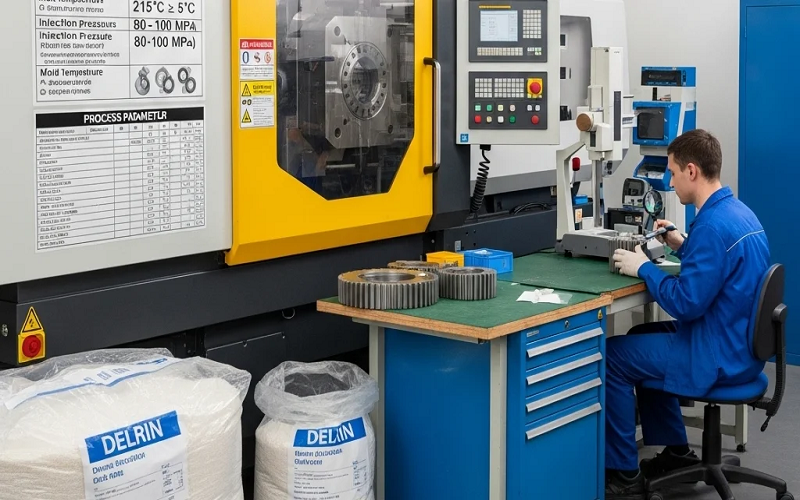
Delrin injection molding offers numerous benefits that make it a preferred choice for manufacturing high-quality plastic parts. Its unique material properties combined with precise molding techniques result in components that excel in strength, durability, and performance across various applications.
High Performance
One of the primary benefits is the material’s exceptional mechanical strength and rigidity. Delrin parts exhibit superior tensile strength and abrasion resistance compared to other acetal plastics, making them ideal for applications that demand durability and long service life.
Corrosion Resistance
Delrin is highly resistant to a wide range of chemicals, including hydrocarbons, solvents, and fuels. This chemical resistance ensures that parts maintain their structural integrity even in harsh environments, such as automotive fuel systems or industrial machinery exposed to aggressive fluids.
Its corrosion resistance also extends the lifespan of components, reducing maintenance and replacement costs.
Dimensional Stability
The precision of Delrin injection molding allows for excellent dimensional stability in finished parts. Despite Delrin’s relatively high shrinkage rate during molding, careful process control and mold design can achieve tight tolerances and consistent part quality.
The superior dimensional accuracy and stability of Delrin injection molded parts ensure a perfect fit between components, significantly reducing errors and unnecessary time consumption during assembly.
Enhanced Assembly Efficiency
By leveraging Delrin injection molding, manufacturers can improve assembly efficiency significantly. Delrin’s excellent flowability allows for the integral molding of complex components, reducing the number of parts and connection points in assembly processes.
Furthermore, the ability to mold complex parts integrally supports automation in production lines, lowering labor costs and boosting throughput.
By leveraging Delrin’s superior mechanical strength, excellent wear resistance, and outstanding dimensional stability, empowering engineers to create innovative, high-performance solutions .
Application Of Injection Molded Delrin Parts
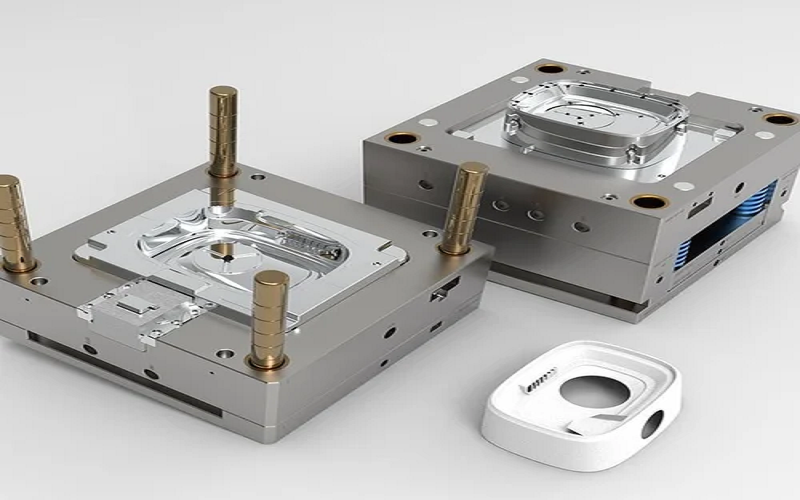
Injection molded delrin parts are known for their excellent dimensional stability, which allows them to maintain their form and tolerances in demanding applications.
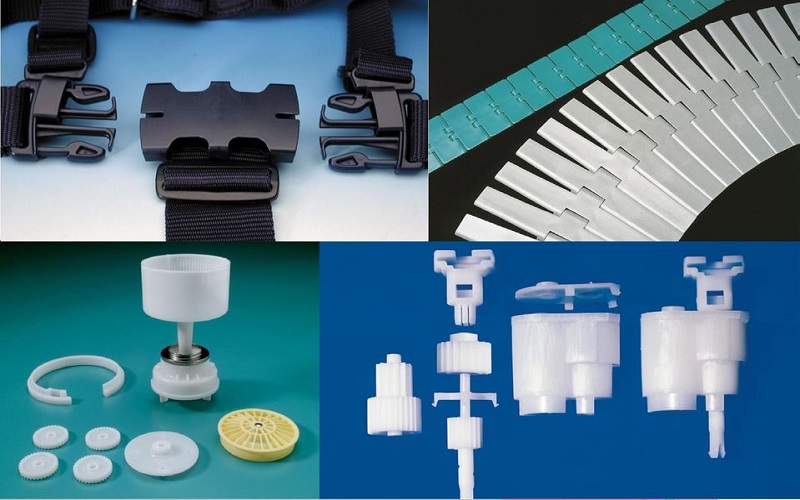
Delrin is commonly used in the automotive and consumer electronics industries for components such as gear wheels, housings, screws, nuts, and pump components.
Delrin’s low coefficient of friction and self-lubricating properties make it reduce wear and extend the service life of parts, minimizing maintenance and downtime.
The material’s high tensile strength and rigidity also enable the production of thin-walled parts and complex geometries, allowing designers to create lightweight yet durable parts that meet stringent mechanical requirements.
Moreover, natural grades of delrin comply with FDA, NSF, and USDA regulations, making injection molded delrin parts suitable for food and beverage applications. This compliance broadens the scope of delrin’s usability, from industrial to consumer-facing products.
Overall, the combination of dimensional stability, mechanical strength, and regulatory compliance makes injection molded delrin parts a versatile choice for high-performance applications.
Conclusion
In conclusion, Delrin injection molding stands out as a highly effective manufacturing process for producing plastic parts with exceptional mechanical strength, dimensional stability, and chemical resistance.
Its unique properties, including superior wear resistance and self-lubrication, enable the creation of complex, lightweight components that enhance product performance and assembly efficiency across diverse industries.
By carefully managing processing challenges and leveraging Delrin’s advantages, manufacturers can deliver durable, high-quality parts that meet stringent application demands, making Delrin injection molding a trusted solution for modern engineering and production needs.