
In modern manufacturing, PBT injection molding is an important engineering plastic injection molding process widely used across multiple industries such as electronics, automotive, and consumer goods due to its excellent mechanical properties, heat resistance, and electrical insulation.
This article introduces the basic characteristics, injection molding process conditions, advantages and disadvantages, and wide applications of PBT plastic, helping readers gain an in-depth understanding of the value and prospects of this high-performance thermoplastic polyester material.
What Is Polybutylene Terephthalate (PBT)?
Polybutylene Terephthalate (PBT) is an engineering thermoplastic polyester synthesized by the reaction of three materials—1,4-butanediol (BDO), dimethyl terephthalate (DMT), and purified terephthalic acid (PTA)—under the action of catalysts.
This composition endows it with good mechanical properties, outstanding heat resistance and chemical resistance.
As a member of the polyester family, PBT offers superior electrical insulation properties, making it highly suitable for electrical and electronic applications.
It also possesses similar performance characteristics to polyethylene terephthalate (PET), with a faster crystallization rate and greater flexibility due to the longer methylene chain.
Its rapid crystallization rate during the injection molding process enables efficient manufacturing with shorter cycle times.
Additionally, PBT can be reinforced with glass fibers or modified with flame retardants to enhance its durability and performance in harsh and extreme environments.
Due to these versatile properties, PBT is widely used in various industries, including automotive parts, consumer electronics, household appliances, and food processing applications.
Properties Of PBT Plastic
Polybutylene Terephthalate (PBT) exhibits a range of outstanding properties that make it a preferred choice for injection molding applications across various industries.
Physical Properties Parameter | Value Range |
|---|---|
Density | 1.3 – 1.4 g/cm³ |
Melting Point | 223 – 235 ºC |
Continuous Use Temperature | 80ºC – 140ºC (unreinforced grades) |
Maximum Use Temperature | Over 200ºC (glass fiber reinforced grades) |
Water Absorption | Approximately 0.1% |
Flexural Modulus | High, significantly increased with reinforced grades |
Compressive Strength | Good, suitable for withstanding mechanical stress |
Dielectric Strength | High, suitable for electrical insulation applications |
Heat Deflection Temperature | Approximately 150ºC (@ 0.45 MPa) |
Mechanical Properties
Its excellent mechanical properties include high strength, rigidity, and toughness, allowing PBT parts to withstand significant mechanical stress and impact resistance. These attributes ensure durability and reliability in demanding environments.
Heat Resistance
The material demonstrates excellent heat resistance, with unmodified PBT grades having a melting point that allows them to withstand continuous service temperatures up to 140ºC, while reinforced PBT grades with glass fiber fillers can endure even higher temperatures, often exceeding 200ºC.
Chemical Resistance
Chemical resistance is another key feature of PBT plastic, showing good resistance against a variety of chemicals including diluted acids, strong bases, alcohols, and hydrocarbons.
However, PBT is susceptible to degradation when exposed to strong acids, strong bases, or hydrolysis in hot water over extended periods, which should be considered during material selection.
Electrical Properties
In terms of electrical properties, PBT exhibits high dielectric strength and excellent electrical insulation capabilities, making it ideal for electrical and electronic applications. Its low dielectric loss ensures reliable performance in insulating components such as connectors, switch housings, and circuit breakers.
Dimensional Stability
PBT also offers exceptional dimensional stability due to its low moisture absorption rate of approximately 0.1%, which helps maintain its shape and size even in humid conditions.
This low water absorption contributes to better long-term performance compared to other plastics like nylon, especially in applications exposed to moisture.
Overall, PBT’s combination of high strength, excellent heat and good electrical properties, make it a versatile and valuable material for producing high-quality plastic parts used in a wide range of applications.
Conditions Of PBT Injection Molding Process
The injection molding process for PBT requires careful control of multiple parameters to achieve high-quality parts with consistent properties. Due to PBT’s rapid crystallization behavior and sensitivity to moisture, specific processing conditions must be followed.
Moisture Content Control
PBT is sensitive to moisture at elevated temperatures, which can cause hydrolytic degradation during molding. Therefore, the material must be thoroughly dried prior to processing to reduce moisture content to below 0.03%. Typical drying conditions involve heating the resin at 120ºC for 2 to 4 hours.
Melt Temperature
The melt temperature for PBT injection molding typically ranges between 240ºC and 280ºC. Maintaining the melt temperature within this range ensures proper plasticization and flow characteristics of the PBT melt in the injection molding machine, preventing defects such as incomplete filling or degradation.
Mold Temperature
The mold temperature significantly affects the crystallization rate, dimensional stability, and surface finish of PBT parts.
For unreinforced PBT, mold temperatures are generally maintained between 40ºC and 60ºC, while glass fiber reinforced grades require higher mold temperatures, typically between 60ºC and 80ºC, to optimize crystallinity and reduce internal stresses.
Injection Pressure and Speed
Injection pressures for PBT range from 60 MPa to 90 MPa, with glass-filled grades requiring slightly higher pressures between 80 MPa and 100 MPa.
A sufficiently high injection speed is necessary to fill the mold cavity before premature crystallization occurs, which can lead to weld lines or incomplete filling.
Cycle Time
Thanks to PBT’s rapid crystallization, molding cycles are typically shorter compared to other thermoplastics. However, cycle times must be balanced to allow sufficient cooling to prevent warpage while maintaining production efficiency.
By adhering to these processing properties and parameters, manufacturers can optimize PBT injection molding to produce parts with excellent mechanical, thermal, and electrical performance suitable for demanding applications.
Parameter | Recommended Range |
|---|---|
Moisture Content | < 0.03% |
Melt Temperature | 240ºC – 280ºC |
Mold Temperature | 40ºC – 60ºC (unreinforced PBT) |
Injection Pressure | 60 MPa – 90 MPa |
Injection Speed | High |
Shrinkage Rate | 0.5% – 2.2% (unfilled) |
Wall Thickness | Minimum 0.7 mm (small parts) |
Draft Angle | ≥ 0.5º – 1º |
Challenges And Limitations Of PBT In Injection Molding
Despite the many advantages of PBT injection molding, there are still some challenges and limitations in practical applications.
Firstly, PBT crystallizes rapidly during the injection molding process. If the injection speed is insufficient or the mold temperature is not properly controlled, the material may crystallize before the mold cavity is fully filled, leading to defects such as weld lines and short shots, which affect the appearance and performance of the product.
Secondly, although the rapid crystallization shortens the molding cycle, PBT has a relatively high shrinkage rate, and the shrinkage rates vary in different directions. Improper handling of these factors can easily cause warping issues.
Designers should fully consider these factors during product design and set appropriate draft angles and fillet radii at corners to minimize stress concentrations caused by sharp corners and reduce the risk of deformation.
In addition, PBT is sensitive to high-temperature moisture. If the moisture content of the raw material is not adequately controlled, decomposition and degradation during injection molding can cause surface spots and darkening, which negatively impact the appearance and performance.
Therefore, reasonable design of wall thickness, fillets, and draft angles, combined with precise process parameter control, is key to ensuring the quality of PBT injection molded products.
Common Applications Of PBT Injection Molded Parts
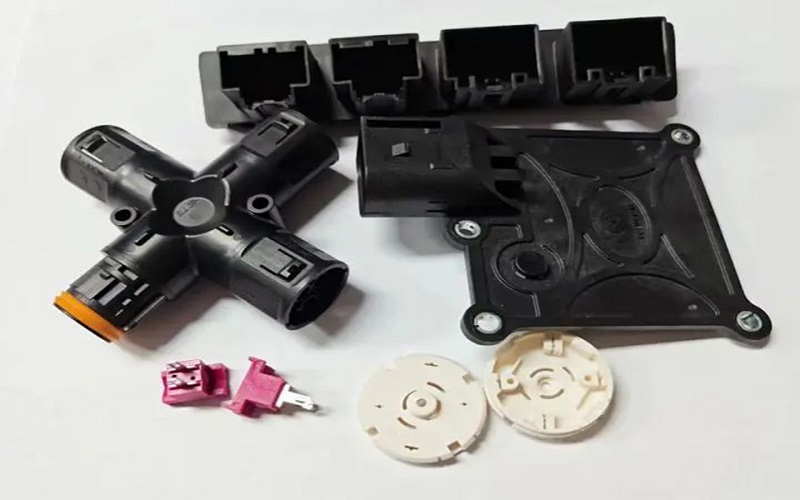
Typical applications of PBT injection molded parts cover various fields including electronic and electrical connectors, automotive engine components, household appliance housings, and food processing equipment.
Its excellent heat resistance, chemical resistance, and good mechanical properties enable it to perform reliably in harsh environments such as high temperatures, humidity, and chemical exposure.
Automotive Industry: Widely used for automotive lighting connectors and sensor housings, ignition coil skeletons, engine covers, and other engine components due to its high heat tolerance and mechanical stress resistance.
Electronics and Electrical: Switch housings, plugs and sockets, relay enclosures, and other components utilize PBT’s superior electrical insulation and flame-retardant properties to ensure product safety and reliability.
Household Appliances: Housings and internal structural parts for washing machines, refrigerators, electric fans, and small kitchen appliances benefit from PBT’s heat and chemical resistance, enhancing product durability.
Food Processing Equipment: FDA-compliant PBT materials are used in food contact parts, ensuring safety, hygiene, and corrosion resistance.
Industrial Applications: Mechanical parts such as gears, cams, and pump bodies leverage PBT’s excellent wear resistance and mechanical strength to meet the high-performance demands of industrial machinery.
These typical applications fully demonstrate the comprehensive advantages of PBT injection molding materials in heat resistance, chemical resistance, and mechanical performance across various industries, meeting the diverse requirements for high-performance plastic materials in modern manufacturing.
Conclusion
PBT injection molding offers a versatile solution for manufacturing durable, heat-resistant, and electrically insulating plastic parts.
Its excellent mechanical properties, rapid crystallization, and chemical resistance make it ideal for diverse industries such as automotive, electronics, household appliances, and food processing.
Proper control of processing conditions and thoughtful design can overcome its challenges, ensuring high-quality, reliable components for demanding applications.